Features
Features and mechanics
The rules behind FourCities, a free railway tycoon strategy game in your browser: cities, cargo chains, locomotives, signals, multiplayer and match lengths.
The map and territories
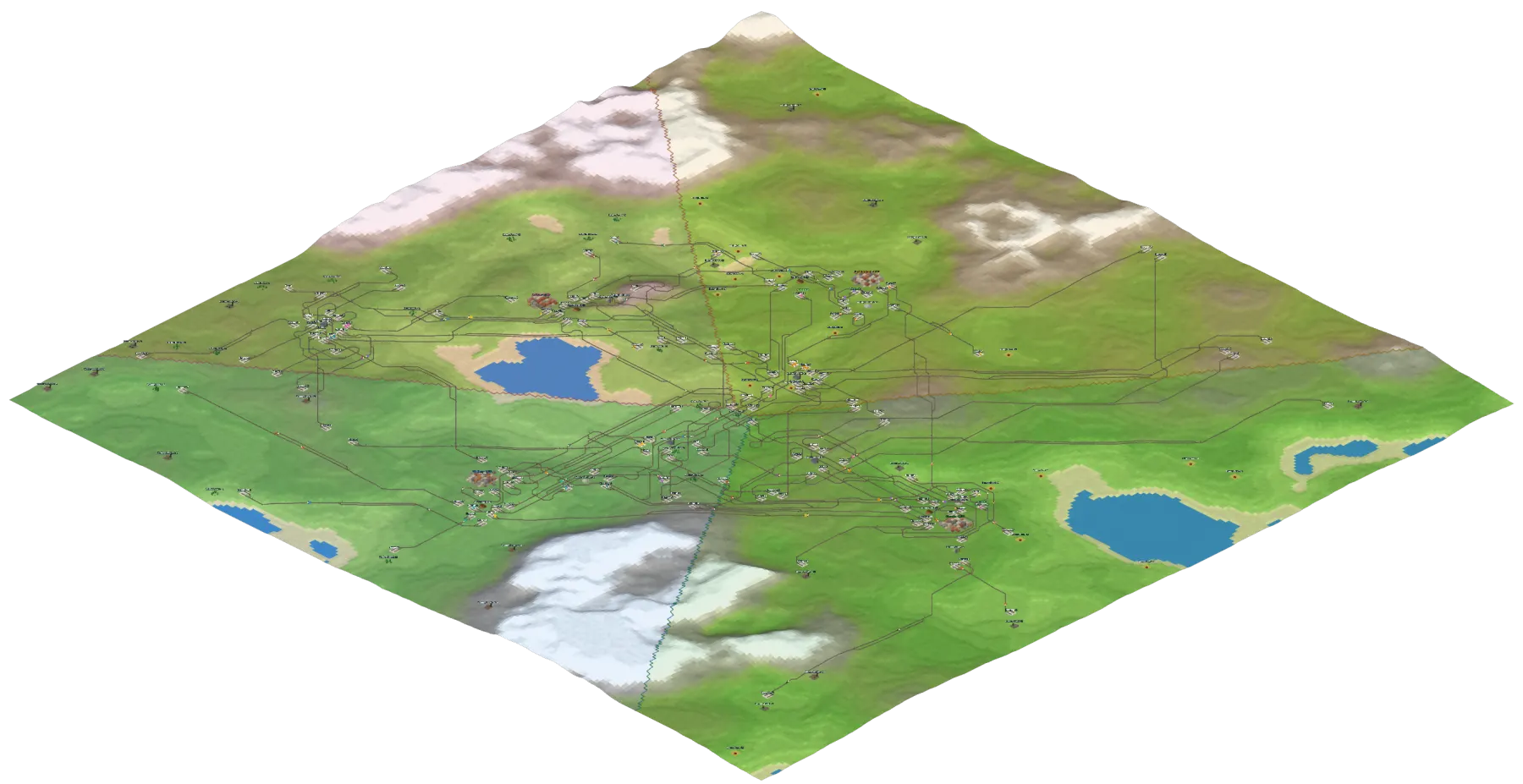
The map is 256 × 256 tiles of 250 metres, or 64 km across, with hills, rivers, lakes and mountains. It is drawn in code from a seed you can choose, so the same seed gives the same map. Track runs in eight directions with 45-degree bends. There is no terraforming: where the ground is too steep the game bridges or tunnels, at four and eight times the normal cost.
There are four cities, each home to one company, and the map is divided into four territories whose borders are fixed when the map is made. Building on someone else’s territory costs three times as much. Every territory has two kinds of raw resource (coal and iron never share one), and oil is found in two of them. Networks are private: you cannot join a rival’s track, but you can cross it at right angles.
Cities and their needs
Every city starts at 5,000 people and grows toward a target. Your city grows from goods your own trains deliver to it and from passenger lines to other cities, with faster lines counting more. As it grows it spreads onto free land in your territory and lays a street grid. Track can cross streets, but not buildings.
| Past | The city also needs |
|---|---|
| 6,000 people | Food |
| 7,500 people | Planks and steel |
| 12,000 people | Fuel |
| 20,000 people | Goods |
Cities keep a stockpile of each good that residents use up every month. A need that stays short for two months stops growth, and a longer shortage pulls a bigger city back down. A city pays less for a good once its stockpile is full. Bigger cities also make more passengers, and the passenger bonus counts in full only if you carry 60% of them. Each factory level employs 800 residents of its owner’s city, so the size of your city limits how many factories you can run.
Cargo chains
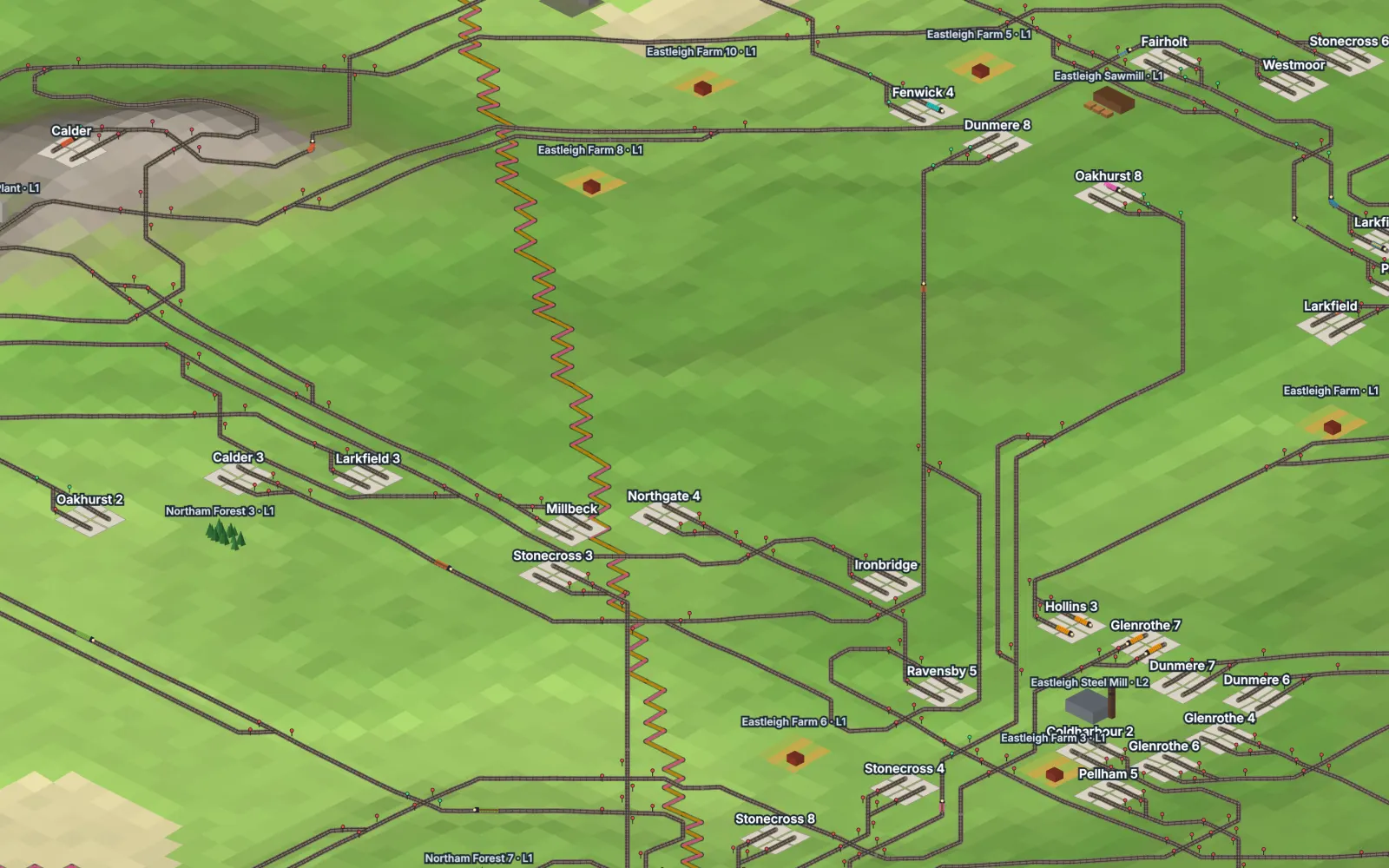
Raw sites sit where the map puts them. Factories are yours to build, but only in your home territory.
| Factory | Takes in | Makes |
|---|---|---|
| Steel Mill | Coal and iron ore | Steel |
| Sawmill | Wood | Planks |
| Food Plant | Grain | Food |
| Refinery | Oil | Fuel |
| Goods Factory | Steel and planks | Goods |
Each delivery pays by tonnes, distance and speed, so a long, fast run beats a short, slow one. A train carries one cargo type, so a line serving two cargoes needs two trains. Cargo waits at stations as packets, and cargo older than 12 months is lost. Anyone can deliver inputs to a factory, but its output loads only at its owner’s stations. When you haul raw cargo out of a rival’s territory, they receive a 15% royalty.
An industry that ships over 75% of its output for six months earns its next level, which doubles its output and which you then pay for. Shipping under 20% for six months while served halves it. Mines and oil wells hold decades of output and close when empty. New sites are found every 30 months.
Locomotives, 1850 to 2035
Twelve fictional locomotives arrive on a fixed schedule: five steam, two diesel, two electric and two high-speed. Locomotives age but never break down. Their upkeep rises 3% for each year of age, up to double. Four technology eras (1850, 1900, 1950 and 2000) raise the track and curve speed limits and bring bigger wagons: 1.5× capacity from 1900, 2× from 1950 and 2.5× from 2000. Track speed limits are 160 km/h in 1850 and 1900, 220 km/h from 1950 and 320 km/h from 2000. There is no electrification to build: electric and high-speed trains run on any track.
| Year | Locomotive | Type | Top speed |
|---|---|---|---|
| 1850 | Ashworth Courier | Steam | 80 km/h |
| 1855 | Kessler Ox | Steam, freight | 55 km/h |
| 1870 | Albion Swift | Steam, express | 110 km/h |
| 1890 | Caledon Mogul | Steam | 90 km/h |
| 1905 | Royal Meridian | Steam, express | 125 km/h |
| 1925 | Hartmann Titan | Steam, heavy | 80 km/h |
| 1938 | Vanguard DE-1 | Diesel | 120 km/h |
| 1960 | Rhine-Ruhr D-1200 | Diesel, heavy | 120 km/h |
| 1965 | Arden E-40 | Electric | 160 km/h |
| 1990 | Solent E-100 | Electric | 200 km/h |
| 2005 | Aurora HS-300 | High-speed | 300 km/h |
| 2035 | Zephyr HS-320 | High-speed | 320 km/h |
A Short match ends in 1900 and a Sprint in 1870, so the later locomotives only appear in a Full match.
Track and signals
Signalling is automatic. Every approach to a junction gets a signal, and every platform end gets an entry signal. You can place or remove signals by hand with the Signal tool. Trains use path signalling: before moving, a train reserves every tile up to the next safe waiting point. If that block is taken, it picks another route, such as the other track of a passing loop, or waits at the signal. Because tiles are reserved exclusively, trains cannot collide.
Trains need somewhere to pass each other. On a network with no junctions away from its stations, platforms are the only places trains can pass, so the game refuses a train that would put as many trains as platforms there. A train never stops with its body on a level crossing. Trains that end up waiting on each other in a circle show as Jammed.
Money, contracts and competition
- Starting cash is €150,000, €250,000 or €400,000, set in the match setup.
- Loans come in €50,000 steps at 6% a year, up to €100,000 plus €40 per resident of your city. Purchases need cash in hand. Running costs can take you to −€50,000, and past that the bank sells your least profitable trains.
- Contracts: cities post an offer every three months. The first company to accept it holds it exclusively. Deliver on time for a bonus, or pay a fine of 25% of it. You can hold two at a time.
- Competing stations: every station has a service rating per cargo, based on how recently a train called and how much is left waiting. Where companies compete for one source, it splits its output by rating squared, so frequent service wins.
- Score is net worth plus your city’s population, weighted by the average net worth per resident across all companies.
Playing solo
- You face three bot companies, each set to Idle, Easy, Normal or Hard. Bots play by the same rules and costs as you and issue ordinary commands.
- Setup lets you pick the map seed, your city (north, south, west, east or random), the starting cash and the match length.
- Pause with Space, or play at 1×, 2× or 4× speed.
- Save and load from the game. The game autosaves every New Year. Saves live in your browser’s own storage, not on a server.
- A tutorial map with idle rivals teaches the first supply chain in a short guided tutorial. On a first visit the start screen leads with it.
- The game can export a replay of a match (the seed and your commands).
Playing online
Choose Online with friends, enter a name and host a room. Share the four-letter room code and others join with it. One server runs the match for everyone, so there is nothing to host yourself and no account to create.
- Up to four players. Every seat starts as a bot, and each friend who joins takes over a bot seat. The host sets the bots’ difficulty and starts the match.
- Online matches run at normal speed, and only the host can pause.
- If you drop out, your seat is held and the match carries on. Reload the page and choose Rejoin to get the full state back.
- Rooms are saved by the server every 30 seconds, so a restart costs players at most half a minute.
Match lengths
| Length | Ends | Time at normal speed |
|---|---|---|
| Sprint | 1870 | about 15 minutes |
| Short | 1900 | about 38 minutes |
| Full | 2050 | about 2½ hours |
One game month takes about 3.75 seconds at normal speed. Short is the default length. A Full match is the only one long enough to reach every locomotive.
What you need to play
A computer with a mouse and keyboard and a current desktop web browser. There is no download and no account. Phones and tablets are not supported for now. FourCities is free, with no ads, and its privacy practices are described on the privacy page.
New to the game? Read how to play, or see the FAQ.
Ready to try it? FourCities is free and runs in your browser. There is nothing to install and no account to make.
Play FourCities